Monday, July 26, 2010

DETOUR

(1945; Edgar G. Ulmer)

There is a moment early on in DETOUR that sets the mood and tone for all which follows… Al Roberts (Tom Neal) and his gal Sue descend from the “Break O’ Dawn Club” into a heavy fog. With each step, it becomes more and more apparent that Sue is leaving him for greener pastures far away… and with each step they become increasingly immersed in the starkly unreal thickness of it all (the fog wranglers really pour it on here). We nearly lose them completely for a moment as Al’s heartbreak becomes certain… and it seems as if he does all he can to keep from choking while delivering his lines in earnest amidst billowy, caustic plumes of the stuff.


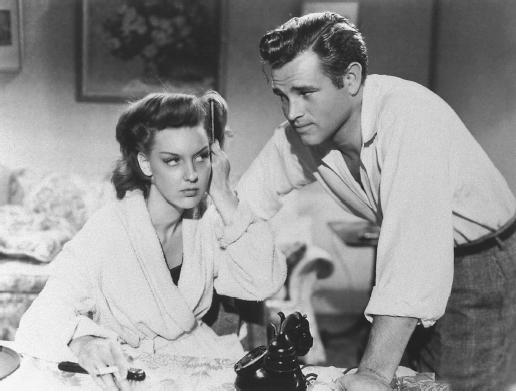
The unforgettable, impossibly dire DETOUR is one of the great legends of the Hollywood noir. It’s reputation is equal parts infamy and excellence… though shot in six days (on a shoestring) and rife with improbable twists, it remains one of the grimmest, most striking archetypes of the genre and features one of the most wicked, definitive femme fatales in screen history in Ann Savage (as the implacable Vera). It’s also filled to the brim with dialogue and narration so hard-boiled and brittle, you’re liable to keep fumbling for the rewind button in incredulous defiance.
We begin with the deeply distraught and grimy Al hitching into a diner on the outskirts of nowhere, looking just as lost and hopeless as a man can get. After some intense brooding nearly gets him tossed out of the place, he begins to narrate his plight (as the room gets dark and the camera pulls in on his sweating, beaten face).

He flashes back to the seedy club in which he plied away his nights (back in New York) playing piano with his singing girlfriend, Sue. Those were the days, he laments… We learn Al’s a bit on the fragile, tender side and desperately in love with Sue, but she leaves him high and dry to wander alone through the foggy streets.
She’s gone to California and he’s now miserable at the club, stricken with her memory… until one night he gets her on the phone to find things aren’t so rosy in dreamland and she misses him. So with little to stand on and scarcely money for food, he decides to hitch to California. At 67 minutes, DETOUR moves swift and terse, with much of the action cobbled together by montage and Al’s gritty narration.
After a long, rough trek, a very weary Al is picked up in Arizona by a bookie named Haskell. Al’s finally relieved as he finds out Haskell’s rolling straight through to L.A., then he notices some bad scratches on Haskell’s hand… “Beauties, aren’t they…I was tusslin’ with the most dangerous animal in da world. A woman.” Haskell continues, “There ought to be a law against things with claws”. “You give a lift to a tomat-a, you expect her to be nice, dontcha?”
When an inexplicable accident during a heavy rain causes Haskell’s death, Al panics, believing the police will surely pin things on him. He hides the body along the side of the road, grabs Haskell’s wallet and hightails it out of there in the Lincoln Continental. After crossing the California border (and finding a good deal of cash in Haskell’s billfold), Al stops at a gas station where fate deals him yet another bad hand. It’s there that he decides to pick up a mysterious, attractive hitchhiker named Vera (Ann Savage in her signature role) and this is where DETOUR really takes off.
Vera, though quite alluring, looks demonic from the get-go… “Man, she looked as if she’d just been thrown off the crumbiest freight train in the world”. She’s guarded and elusive during their first shared words. “You look like a Phoenix girl to me.” “Are all the girls in Phoenix that bad?”, she drolly retorts. After a short nap while Al drives, she springs to life as if shot out of a cannon, wild-eyed and accusing him of killing Haskell and stealing his car/money, etc.
Al quickly realizes this is the girl Haskell spoke of, the “animal” he’d tussled with. From here on, Ann Savage viciously bulls her way through every line with an unrivaled authority… “You know, as crooked as you look, I’d hate to see a fella as young as you wind up sniffin’ that perfume in Arizona they hand out free to murderers”. Within a few short minutes she’s completely established her dominance, blackmailing him into submission (“just remember who’s boss around here!”). The stunned, thoroughly emasculated Al can do little but grovel wearily at her side and drive.

Once they get to L.A., Vera’s scheming to use Al to sell the car and much more, refusing to let him out of her sight. They rent an apartment in which she stalks around seductively, drinking whisky in abundance and passing sexual innuendo at every turn… though he despises her completely and seems more frightened (and disgusted) than aroused by her predatory lusting. And during these moments, his plight becomes irretrievably, almost mockingly hopeless…
Director Edgar G. Ulmer accomplishes so much with so very little. Using a few spare sets and a lot of rear-screen projection driving scenes, he was able to create an improbable masterpiece in 6 days for under 40 grand (shooting for poverty-row PRC studios). Martin Goldsmith’s seedy, grim and habitually implausible script sizzles nonetheless, mostly due to the amazing performance by Ann Savage (though Tom Neal is terrific as well). DETOUR is a desperate, haunting melodrama drawn in broad strokes… with a penchant for cruelty that can feel like an emotional sucker punch.
Though it would seem ridiculous that the unarmed Vera could so easily threaten and control a man she’s accusing of murder (out on a deserted stretch of road), her performance is chillingly convincing. Vicariously, you’re vulnerable, threatened (and, let’s face it… hopelessly turned on) by her throughout. If you ever meet a scowling devil-woman like Ann Savage, no matter how attractive you find her, DO NOT give her a lift. Remember these words, lest they’ll haunt you to your dying gasp (as you’re sniffin’ that Arizona perfume…).


Wednesday, July 14, 2010

DEMONS

(DEMONI; Lamberto Bava; 1985)
Way out there in the vast beyond lies another similarly battered cultural wasteland of wild hair, unpalatable clothing trends and aggressive pimps demanding to instruct the voice of reason. What if, say, Italians pretended to be Germans, who in turn pretended to become “demons” who just want to rip your throat out and drool and snarl a lot and hopefully cause you nightmares.
The story, a bit on the loose side (if you know what I mean…), begins on a subway where a wide-eyed priggish gal named Cheryl (Natasha Hovey) finds herself all hot and bothered by a colorful menagerie of new wave-types, then is further distressed by a menacing, uber-hip, shiny masked mute who stalks her through the dark, empty corridors of the mall-ish netherworld that is her local train station, only to confront her with free passes to a new movie theater. All of this is set to the most-excellent “Demons” theme song, a spooky-cool industrial synthesizer jam by Claudio Simonetti (of GOBLIN).
So she thinks, “Wow, cool”, and invites her sassy, frizzy-haired pal Hannah (Fiore Argento, the oh-so tasty “other daughter” of Dario) to go with her. For the record, the Metropol, the West Berlin movie palace in which the majority of DEMONS takes place, remains my all-time favorite “in movie” movie theater. Where else can you go for a couple of hours only to find the exits mysteriously, inexplicably bricked in when you
try to leave? It also seems a fine place to find a wide array of cross-cultural stereotypes (circa 1985), such as “Tony the pimp” (the implacable Bobby Rhodes), the movie’s much-beloved de facto anti-hero.
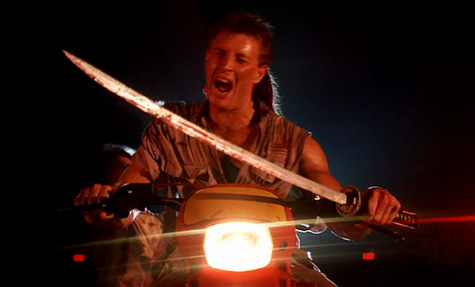
So in the theater lobby there’s this swanky crotch-rocket motorcycle on which an S & M-geared mannequin sits holding a samurai sword in one hand, a silver devil mask in the other…ok, well it is the 80s. Anyways, Tony’s mischievous #1 ho, Rosemary (Geretta Geretta), tries on the mask, which leaves an ominous bloody scratch on her cheek. Foreboding as that is, wait until you meet the rest of the cast, who look like a pack of refugees from a Mentos’ commercial.

As Cheryl and Hannah settle into their seats to watch the horror film, a couple of dapper pretty-boys insinuate themselves next to the gals, anxiously hinting their “potential suitor” status throughout.

After Motley Crue’s “Save Our Souls” kicks off the movie’s intro (setting the tone for all which follows), the plot refers to a Nostradamus prediction foretelling the “coming of the demons” and in one scene a character finds a silver mask identical to the one in the theater’s lobby, which scratches his face just as it did Rosemary’s. Well, it doesn’t take long for his scratch to become infected and turn him into a “demon”, which cues Rosemary to head to the bathroom just as her face starts going all *Cronenberg* on her.

Fanged, clawed, drooling and ferocious, the demons (some of the coolest, scariest monsters to ever grace the silver screen) wreak havoc on the terrified crowd… and as they ravenously spread their contagion through their claws, one by one their victims become possessed, joining their ranks. Whether poking and prodding out a blind man’s eyes, viciously scalping a shrieking, terrified woman or just ripping the throat out of a random passerby, the demons’ modus operandi is simply to raise hell.
Part zombie, part devil and all bloodthirsty fiend, the preposterous phenomenon of the demon is never reasonably justified or explained… the viewer is simply served up a feral hair-metal rendering of their worst nightmares. And as one unfortunate moviegoer finds out, they’ll rip your nuts off clean through the drawstring sweats and tighty whities you hide them in.  Oh... wait a second.  That actually occurred in the very similarly plotted (and equally awesome) sequel, DEMONS 2, produced a year later.
Like much of the production (including the ridiculously confusing script), the acting, dialogue and dubbing are often silly and atrocious… perhaps even doubly so set to glam-metal tirades by Accept, Saxon, and Pretty Maids. Yet all that aside, DEMONS is one of the most memorable horror films of the 1980s, an absolutely entertaining and exhilarating fright show with as many unintentional laughs as there are gruesome thrills and chills.
Produced and co-scripted by Dario Argento and directed by Lamberto Bava, DEMONS is loaded with cheap shock moments and scares by the bucket load, running the gamut of gory spectacle and grisly mayhem. And Sergio Stivoletti deserves endless accolades for his make-up and gore effects, creating the truly horrific demons (and the carnage they exact) with as much panache and ingenuity as almost any Hollywood special effects master could’ve mustered.
DEMONS is my idea of the perfect Grimm fairy tale for children, except without anything in the way of a morality lesson or conscience whatsoever. If you want to make small children cry hysterically until their eyes burn out and raging torrents of snot run down their precocious little chins, show them DEMONS.


Friday, July 2, 2010

ZPG: ZERO POPULATION GROWTH

(1971; Michael Campus)

Russ and Carol McNeil are lost in a nightmare of caustic, murky smog, a world where the oppressed wander blind and hungry through the surreal haze of a police state, a future where resource and space restriction has rendered child-bearing a capital offense... ZPG creates such a place, one that forebodes nothing more fantastic than the inevitability of things to come. Preservation of the species is key, the last fundamental, the purest virtue…
As far as science fiction premises go, this one in particular seems to promise much in regards to self-examination and thoughtful ruminations on the struggle between heart and mind. If the world represented in ZPG is that of a police state, it is one by virtue of necessity… it is policy written not only in logic, but in the desperation of survival and lamentation of all the mistakes mankind had wrought to reach the brink of extinction. The world governing body has declared child-bearing illegal for thirty years, a decree punishable by death. But despite necessity, people are desirous, decadent creatures whose logic is often clouded by emotion. And in ZPG, mass depression has become the norm and cold, analytical (and forceful) psychiatric assistance is the mere push of a button away.
The story begins with the government edict being announced to the stunned, indignant populace. The first shrill cry of shock and revolt is that of a woman, signaling ZPG’s somewhat disharmonious emphasis on the maternal instinct throughout. So eight years later we’re brought to a long line waiting to get into Baby Land, a company where couples buy needy, clamoring child-like dolls programmed to simulate, instruct and fill the presumptive void. Russ (Oliver Reed) and Carol (Geraldine Chaplin, daughter of Charles Chaplin) wait in line stoically, then anguished in view of the spectacle and illogic of the previous couple’s doting over the scarcely realistic doll, grieving their dilemma as they leave empty handed.
Into the haze (in which everyone must where oxygen masks) they stroll impassively, deciding to dine at a nice restaurant. Such is their lament though, as violin and piano accompaniment doesn’t make the pasty rations any more appetizing… shaking his head, Oliver Reed ponders “I wonder what the Hamburger Monte Christo… would taste like” as if this predicament had just recently been thrust upon them.
So the future isn’t so dandy, as next we wait in a long line to get into a museum of history where we find almost every species aside humanity has become extinct. This is where Russ and Carol work as performers in an exhibit enacting presumed scenarios from 1971 (in which they and their neighbors play swingers, one of several humorous indulgences provided). While spectators wait in line, a museum announcer informs us the true cause of the present atmospheric conditions (called the “smog blanket age”) were the “unrealistic and inept policies of the leaders of industry. The crimes committed by them were further perpetrated by the political and religious leaders, who irresponsibly allowed the equally devastating crime of overpopulation”.
This at first would seem to instruct the conscience and motive of ZPG (viewing the film nearly 40 years out of context), its ambivalence, its “mind” as opposed to its characters’ “hearts”. It’s a conflict of ideals briefly introduced, but ultimately usurped by Carol’s intentional pregnancy and the couple’s desperate desire to be parents. From the moment Carol decides not to step into the abortion machine in their bathroom (what about mass sterilization?), the film becomes sharply resolute in the McNeils’ plight, never questioning their selfishness or the moral implications of their decision. It’s simply them versus a cold, wrathful police state… and don’t forget how beautiful and precious babies are.
There are several fine moments in ZPG, as well as a few missteps and lapses in logic. The McNeils' best friends, co-workers and neighbors, George and Edna Borden (Don Gordon and Diane Cilento), provide some of the focal point and later conflict as a couple who’ve opted for one of those doll children. Perhaps the best scene involves Edna’s abandonment of Peter, her artificial son. Her psychologist suddenly appears on her wall-screen pleading her to return to Peter, “he needs you, he needs you, he’ll die without you, he loves you, Edna”. All the while, the doll also pleads incessantly for his “mummy”. In a moment both amusing and haunting, Edna caves in emotionally and rejoices in her love for the doll.
When Russ attempts to research childbirth at the library computer, he’s drawn into an interrogation chamber where he’s tortured, his clever alibi just barely fooling the library security chief and staving off further incrimination (in a rather Orwellian moment of harrowing intensity).
In another pivotal moment, the McNeils witness a young husband and wife with baby corralled into a public square (with a malicious crowd of onlookers screaming “baby!” repeatedly) as an execution chamber is lowered over the pleading, hysterical couple from a ship above. Later, when Carol gets panicky about her baby’s perceived fever, we get several infuriatingly contrived scenes in which she walks around in public, hardly concealing the crying infant- the most ridiculous of which occurs in a quiet, packed theater as the baby whines uncontrollably. Later George and Edna find out the McNeils’ secret, blackmailing them into sharing the baby, with predictable results.
Despite some heavy-handedness, ZPG has an evocative, moody atmosphere that has aged exceptionally well and is still quite thrilling and thought-provoking. Oliver Reed is perfectly cast in a role custom-made for his trademark brooding (the few seconds he’s afforded to smile, he seems agonized in doing so). He seethes with antipathy for almost everything, including his own emotions. The climax of the McNeils’ ordeal requires a bit in the way of suspension of disbelief, though by this point the audience has already endured several such improbable moments and should be conditioned to it. With a film such as this, you more or less need to go with the flow to reap it’s rewards. Director Michael Campus, who made his debut with this minor classic, would inexplicably follow it with the infamous 1973 pimp how-to guide, THE MACK.
Alas, ZPG is a story rooted in emotion, it’s fiery rhetoric a heartfelt plea for love. Though it’s a message riddled with ambivalence and confusion, it’s a relic of it’s time and a fine testament to the spirit of classic science fiction- and certainly more intelligent and memorable than most of the action-based piffle that passes for sci-fi these days.